
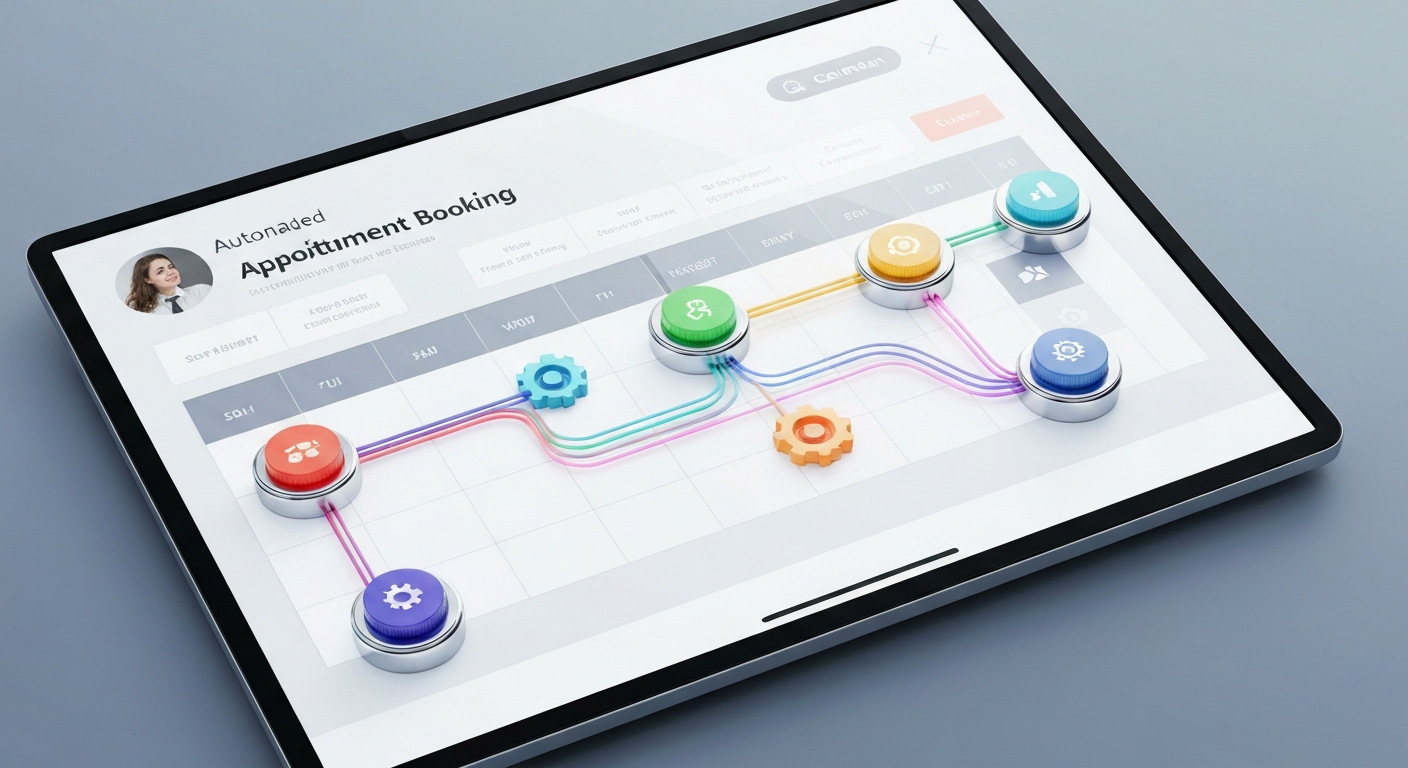
How to Automate Appointment Booking and Reclaim Your Freedom
For many entrepreneurs, the dream of acquiring or launching a business is rooted in a desire for freedom. Yet, a harsh reality often awaits them on the other side of the closing documents. Many founders quickly realize they haven't actually bought an asset; they have bought a highly demanding full-time job that follows them everywhere.
One of the most insidious bottlenecks causing this trap is the frontline appointment booking process.
When a business relies on manual scheduling, it fragments the owner’s attention across a chaotic mix of phone calls, texts, emails, and social media direct messages. A typical booking can easily consume four to six back-and-forth messages just to secure a single time slot—not to mention the subsequent manual entry, confirmation tracking, and chaotic weekend rescheduling. (If you want to handle calls automatically, see what tasks an AI receptionist can handle).
The business stops running on a predictable schedule; instead, the owner spends their entire life running the business's calendar.
[ Inbound Lead Channels ] ──> [ Owner's Interrupted Attention ] ──> [ Manual Calendar Entry ]
(Phone, SMS, Insta DM, Email)       (Every 4 Minutes, 24/7/365)          (High Error Risk)
If your business operations break the moment you stop checking your phone, the operation isn't stable—it is simply being continuously patched by your stress tolerance. To scale an enterprise and preserve your mental focus, you must shift from a model of human improvisation to one of system trust.
Here is the operational blueprint for automating your appointment scheduling, establishing a single source of truth, and safely stepping out of the critical path of your own frontline.
1. The Core Architecture: Building Your Automated Stack
A highly functional, scalable booking ecosystem does not require overcomplicated, cutting-edge software infrastructure. It requires a clean scheduling core paired with rigid communication automation rules that systematically eliminate human decision points.
To build a reliable "starter stack," an entrepreneur needs four fundamental structural blocks:
- The Brain (Scheduling Source of Truth): This is the centralized engine where your real-time availability lives. Platforms like Calendly offer rapid deployment, while Acuity Scheduling provides robust intake forms. The non-negotiable rule of this architecture is that only one software system is permitted to dictate availability.
- The Front Door (The Booking Interface): This is the public-facing touchpoint for the consumer. It includes embedded widgets on your primary website, clear links in social media biographies, and physical QR codes placed strategically at your storefront.
- The Communication Layer (The Notification Matrix): To minimize operational friction, every customer state change must trigger an automated workflow. Short Message Service (SMS) text messaging should serve as your primary tool due to its high open rates.
- The Integration Layer (The Operational Glue): Utilizing native integrations or automation platforms like Zapier or Make, the system ensures that data flows effortlessly between your calendar, your communication tools, and your internal CRM.
2. Managing Internal Friction: Enforcing the "System of Record"
The ultimate failure point of most automated booking systems is not a technical glitch; it is internal employee bypass. When first rolling out an online calendar, frontline staff members will frequently try to play the "hero" by answering phone inquiries and manually squeezing customers into slots that the system has deliberately blocked off.
While employees believe they are providing helpful customer service, this behavior creates hidden debt in the schedule, triggers double-bookings, and erodes the team's overall trust in the software. (This operational consistency is exactly why shoppers trust businesses with good reviews).
To lock in internal alignment, leadership must establish a strict, non-negotiable "single source of truth" framework:
"If an appointment is not recorded inside the automated booking system, it does not exist."
Good operators do not rely purely on employee discipline; they design workflows that make compliance easier than bypassing. First, restrict user permissions. Second, enforce a "no double entry" mandate. Finally, leadership must reframe the company culture.
3. The Psychology of Helpful Redirection
Once your internal staff respects the system, you must gracefully train your customer base to embrace the digital workflow. When a client calls or texts requesting a manual slot, your team must never respond with defensive, self-serving phrases like "We don't take bookings over the phone."
Instead, execute a strategy of helpful redirection. The core psychological pivot relies on framing the automation as an immediate benefit to the customer's time and convenience, not your business's efficiency.
                  ┌────────────────────────────────────────┐
                  │ Customer Calls Demanding Manual Booking │
                  └───────────────────┬────────────────────┘
                                      │
                                      ▼
                  ┌────────────────────────────────────────┐
                  │   Execute Phrase: Helpful Redirection  │
                  └───────────────────┬────────────────────┘
By maintaining a warm, consultative tone and immediately dispatching the link via SMS while still conversing, you guide the customer's behavior without spark-inciting confrontation. Over time, consumers quickly internalize a simple operational pattern: the phone is for guidance, but the link is for immediate execution.
4. What to Expect: The 30-Day Reality Check
Transitioning a business from manual scheduling chaos to a streamlined digital workflow is rarely a perfectly linear transformation. It is typically characterized by a month of controlled turbulence followed by sudden operational clarity.
Days 1–7: The Uncomfortable Phase
During the initial week, anxiety usually peaks. Staff members may still attempt minor workarounds out of old habits, and a small segment of your customer base might express initial confusion.
Days 8–14: Setting the Rules
By the second week, internal enforcement begins to take hold. As managers rapidly correct team workarounds, staff behavior stabilizes.
Days 15–21: The Flattening of Chaos
By week three, an operational inflection point occurs. Inbound phone interruptions, chaotic text threads, and administrative distractions drop dramatically. Your digital calendar begins filling up predictably.
Days 22–30: System Trust Established
By the conclusion of the first month, the psychological shift is complete. Bookings flow seamlessly into your business model without manual human oversight.
5. The Measurable ROI of Frontline Automation
When an appointment-based business fully commits to an automated scheduling framework, the return on investment (ROI) transforms the entire organization across four distinct metrics. (This pairs perfectly with understanding how Google reviews affect your business reputation).
| Metric Category | Manual Operations | Automated Operations |
|---|---|---|
| No-Show Rates | 12% – 18% | 5% – 8% (Driven by automated alerts) |
| Completed Bookings | Heavy leakages | 10% – 40% Increase |
| Staff Capacity | 10 – 20 administrative distractions daily | Near-zero routine booking interruptions |
| Owner Context-Switching | Constant micro-decisions | Asynchronous operational flow |
Conclusion: Refuse to Be the Scheduling System
The most critical takeaway for an exhausted business owner is understanding that optimization is not about working harder within a broken framework; it is about removing yourself from the critical path of daily routine tasks. Every single time you step in to manually answer a booking request, you are actively training your business to depend on your personal availability rather than your systems.
Stop optimizing for your personal responsiveness, your memory, and your threshold for stress. Turn on a centralized booking tool, embed a public link, and commit to sending that link to every single incoming request.
The goal is not to casually work less at some ambiguous point in the future. The goal is to stop your business from interrupting your personal life every four minutes starting this week. Step away from the frontline, trust the automation architecture, and finally give your business the room to grow—and yourself the room to breathe.