

Why Local Shoppers Trust Google Reviews in 2026?
Google reviews are the most trusted source of local business information because they combine authentic consumer experiences with active platform governance that removes fraud at scale. Understanding why local shoppers trust Google reviews helps you use them more confidently and avoid the common traps that lead to poor purchasing decisions. A 2024 Reputation survey found that 54% of consumers trust online reviews more than recommendations from friends, family, or influencers. That number reflects a fundamental shift in how people gather information before spending money locally.
Why do local shoppers trust Google reviews?
The short answer is that Google has built trust through enforcement, not just reputation. The platform actively removes fake reviews, suspends violating accounts, and blocks inaccurate edits before they reach consumers. This ongoing governance creates what researchers call a reliable “trust surface,” meaning the reviews you actually see have already passed through multiple layers of verification.
Google’s anti-fraud systems operate at a scale most people do not realize. The company has removed over 292 million policy-violating reviews and 13 million fake Business Profiles in recent years. That volume of enforcement directly shapes what you encounter when you search for a local restaurant, dentist, or contractor on Google Maps.
Beyond raw removal numbers, the platform uses Gemini AI models alongside human analysts to detect suspicious patterns in real time. Gemini models automatically block unhelpful or policy-violating edits before they go live, which means the review ecosystem is being curated continuously rather than reactively. This proactive approach is a significant reason why Google reviews carry more weight than reviews on platforms with weaker enforcement.

Transparency also plays a role. When Google detects suspicious activity around a business profile, it can temporarily restrict new reviews and notify users. This visible accountability signals to shoppers that the platform takes integrity seriously.
Pro Tip: When you notice a business has a temporary review restriction notice on its Google profile, that is actually a sign the platform is working as intended. It means Google flagged unusual activity and stepped in before misleading content could influence your decision.
What psychological factors make Google reviews persuasive?
Trust in Google reviews is not purely rational. Two well-documented psychological mechanisms drive it: social proof and information diagnosticity.
Social proof is the principle that people look to others’ behavior to guide their own decisions. When a local plumber has 340 reviews, you interpret that volume as evidence that hundreds of real customers made a real decision. The sheer number of experiences reduces your uncertainty before you even read a single word. This is why a business with 300 reviews at 4.4 stars typically feels more trustworthy than one with 12 reviews at 5.0 stars.
Information diagnosticity is a concept from consumer psychology that explains why some reviews feel more useful than others. A review is diagnostic when it reduces your uncertainty by providing authentic, relevant, and balanced content. Research on hybrid review systems confirms that perceived authenticity and objectivity jointly increase consumer trust and decision confidence. Reviews that describe specific situations, name particular staff members, or explain what went wrong and how it was resolved score highest on diagnosticity.
“Information diagnosticity theory explains that shoppers trust reviews that reduce uncertainty with authentic, relevant, and balanced content.” This is why a detailed three-paragraph review from a verified customer carries more persuasive weight than ten one-sentence five-star ratings.
The emerging category of hybrid reviews, which combine human emotional narrative with AI-generated summaries, is raising the bar further. Google’s AI-generated review summaries on Maps pull patterns from hundreds of individual reviews and present them as structured insights. This format gives you the emotional authenticity of human writing and the objectivity of aggregated data in one place.
- Social proof: High review volume signals that many real people chose this business and reported back.
- Diagnosticity: Detailed, specific, and balanced reviews reduce your decision uncertainty more than vague praise.
- Hybrid systems: AI summaries combined with human reviews improve both confidence and speed of decision-making.
- Recency signals: Fresh reviews confirm the business is still operating at the standard described.
Which review factors most influence shopper trust?
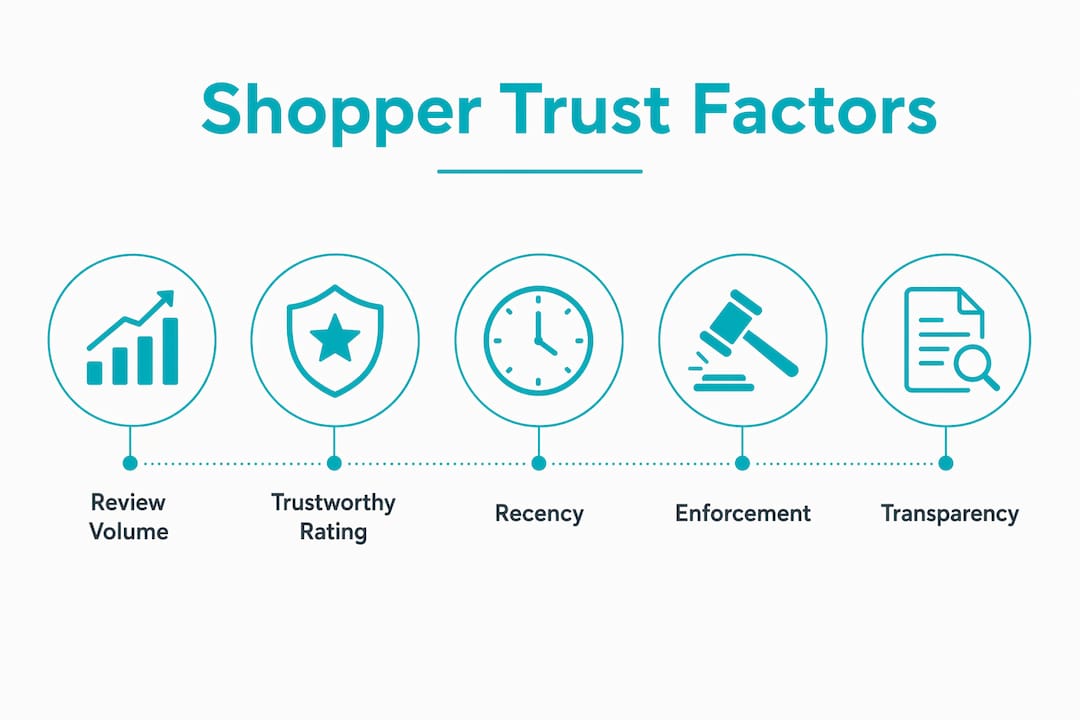
Not all review signals carry equal weight. Understanding the specific factors that build or erode trust helps you read Google reviews with more precision.
| Trust factor | Why it matters |
|---|---|
| Review volume | Higher counts signal real business activity and reduce the chance that a few outliers skew the picture. |
| Recency | 74% of consumers care about reviews written within the last three months. Old reviews may reflect a business that has changed significantly. |
| Rating range | Ratings between 4.2 and 4.7 convert best because they feel authentic. A perfect 5.0 score often raises suspicion. |
| Review diversity | A mix of positive, neutral, and critical feedback signals that reviews are genuine rather than curated. |
| Reviewer specificity | Reviews that name specific staff, describe particular services, or reference dates carry more credibility than generic praise. |
The rating sweet spot deserves special attention. Ratings between 4.2 and 4.7 outperform perfect scores in conversion because consumers understand that no business satisfies every customer. A 5.0 average with hundreds of reviews triggers skepticism rather than confidence. This counterintuitive dynamic means you should actually be more cautious about a business with a flawless score than one with a realistic, slightly imperfect rating.
Review volume also feeds directly into Google’s local ranking algorithm. Review count and scores influence local prominence, one of the three factors Google uses to determine which businesses appear in local search results. This creates a reinforcing loop: businesses with more reviews rank higher, get more visibility, and attract more reviews.
Pro Tip: Sort Google reviews by “Most Recent” rather than “Most Relevant” when researching a local business. Recency tells you whether the current ownership and staff are maintaining the standards that earned earlier praise.
What are the common pitfalls in interpreting Google reviews?
Google reviews are reliable, but they are not infallible. Knowing where the system has weaknesses makes you a sharper consumer.
- Star ratings can mislead. Online ratings emerge from multi-stage processes subject to selection bias, expectation distortion, and strategic manipulation. A business that attracts only highly satisfied or deeply dissatisfied customers will show a skewed average that does not reflect the typical experience.
- Selection effects shape who writes reviews. Most customers who have a neutral or mildly positive experience never write a review. The people who do write are disproportionately those with strong feelings in either direction. This means the average rating reflects the extremes more than the middle.
- Fake reviews still exist despite enforcement. Google removes hundreds of millions of violating reviews, but coordinated fake review campaigns continue to operate. Patterns to watch for include a sudden spike in five-star reviews over a short period, reviews with no reviewer history, and reviews that use identical or near-identical phrasing.
- Incentivized reviews distort authenticity. Some businesses offer discounts or gifts in exchange for reviews, which violates Google’s policies but still occurs. These reviews tend to be uniformly positive and light on specific detail.
- Responding to reviews signals engagement, not just reputation. Business responses to reviews improve local visibility and signal attentiveness. A business that never responds to negative reviews tells you something about how it handles customer problems in real life.
How to use Google reviews to make better local purchasing decisions
Reading Google reviews effectively is a skill. These practices help you extract reliable signal from the available information.
- Prioritize volume and recency together. A business with 200 reviews and 40 written in the last three months is more trustworthy than one with 500 reviews and nothing recent. Both signals matter.
- Read the negative reviews first. Critical reviews reveal the specific failure modes of a business. If the same complaint appears repeatedly, that pattern is more informative than any single five-star endorsement.
- Check for reviewer authenticity. Click through to reviewer profiles. Accounts with review histories across multiple businesses and categories are more credible than accounts with a single review.
- Treat the star rating as a filter, not a verdict. Use the 4.2 to 4.7 range as your baseline heuristic, then read the content to understand why customers rated the business that way.
- Look at how the business responds. A thoughtful, specific response to a negative review demonstrates accountability. A defensive or dismissive response is a red flag regardless of the overall rating.
- Use Google’s AI summaries as a starting point. The structured summaries on Google Maps aggregate patterns from hundreds of reviews and highlight recurring themes like “friendly staff” or “long wait times.” They save time and surface consensus quickly.
You can also learn more about how reviews shape reputation to understand the broader dynamics at play when you are evaluating a local business.
Pro Tip: Use Google Maps filters to view reviews by star rating. Reading the two-star and three-star reviews specifically often reveals the most honest and nuanced accounts of a business, since those reviewers are neither thrilled nor outraged.
Key takeaways
Local shoppers trust Google reviews because the platform combines active anti-fraud enforcement, social proof dynamics, and specific review quality signals that collectively reduce consumer uncertainty and support confident purchasing decisions.
| Point | Details |
|---|---|
| Platform enforcement builds trust | Google removed 292M+ fake reviews, creating a curated trust surface that shoppers rely on. |
| Rating sweet spot matters | Ratings between 4.2 and 4.7 signal authenticity; perfect 5.0 scores often indicate manipulation. |
| Recency outweighs volume alone | 74% of consumers prioritize reviews from the last three months over older, larger review counts. |
| Read content, not just stars | Star ratings are distorted by selection bias; detailed review narratives provide more reliable signal. |
| Business responses are trust signals | How a business replies to negative reviews reveals its real customer service standards. |
The case for informed trust, not blind trust
I have spent years watching how consumers interact with Google reviews, and the pattern I see most often is this: people either trust reviews completely or dismiss them entirely. Both extremes are wrong.
Google’s enforcement infrastructure is genuinely impressive. Removing 292 million violating reviews is not a marketing claim. It is a real operational commitment that shapes what you see every time you search for a local business. The platform is not perfect, but it is actively maintained in a way that most review platforms are not.
That said, the research on rating distortions is equally real. Star averages are blunt instruments. They compress complex, multi-dimensional customer experiences into a single number, and that compression introduces noise. A 4.3 from a business with 400 detailed reviews is a very different signal than a 4.3 from a business with 22 brief ones.
My honest position is that Google reviews deserve your trust as a starting point, not as a final verdict. The platform’s governance gives you a reasonably clean dataset to work with. Your job is to read that dataset critically. Look for specificity, recency, and patterns across multiple reviews rather than anchoring on the aggregate score. The shoppers who do this consistently make better decisions than those who either accept or reject reviews wholesale.
The hybrid review future, where AI summaries sit alongside human narratives, will make this easier. But the underlying skill of reading reviews critically will remain valuable regardless of how the technology evolves.
— Aigars
How Gainmoreleads helps businesses earn the reviews shoppers trust

The trust signals described in this article do not appear by accident. Businesses that consistently earn high-quality, recent, and detailed Google reviews do so because they have systems in place to request and manage feedback at scale. Gainmoreleads builds those systems for local businesses through a combination of automated review generation and local SEO strategy. Clients using GML’s foundation and automation services have seen up to a 270% increase in leads directly tied to improved review profiles. If you want your business to show up where local shoppers are already looking and trusting, explore what Gainmoreleads can do for your reputation at gainmoreleads.com/pricing.
FAQ
Why do shoppers trust Google reviews more than other platforms?
Google’s active enforcement removes over 292 million fake reviews and uses Gemini AI models to block policy violations in real time, creating a more reliable review environment than most competing platforms.
What star rating range is most trustworthy on Google?
Ratings between 4.2 and 4.7 are considered most credible because they reflect realistic customer experiences. Perfect 5.0 scores often signal manipulation or a very small review sample.
How recent do Google reviews need to be to be useful?
74% of consumers consider reviews written within the last three months most relevant. Reviews older than six months may not reflect current business quality, ownership, or staff.
Can you spot fake Google reviews?
Yes. Look for sudden spikes in five-star reviews, accounts with no review history, and reviews using identical phrasing. Google removes these at scale, but patterns in timing and language are the clearest indicators.
Do business responses to reviews affect shopper trust?
Business responses improve local search visibility and signal customer service standards. A specific, respectful response to a negative review builds more trust than ignoring it or responding defensively.